
Designing a self-serve insights platform for global research teams
CINT
At Cint, I worked as Lead Product Designer on AccessPro and Track — two products designed to modernise how companies run consumer research at scale.
Cint is one of the world’s leading research technology platforms, helping brands and agencies access survey respondents across more than 130 countries. The platform automates market research operations that were traditionally slow, manual and expensive.
My role focused on transforming complex research workflows into intuitive self-serve tools that enabled both enterprise and SME customers to launch, manage and analyse studies independently.
The challenge
Market research platforms are notoriously complex.
Researchers often rely on fragmented workflows, spreadsheets, repeated survey setup tasks and manual reporting processes. At Cint, many customers still depended on account managers or specialist support teams to perform recurring actions such as:
Creating repeat tracking studies
Managing longitudinal surveys
Configuring audience targeting
Monitoring quota fulfilment
Exporting and analysing results
This created three major problems:
Slow time-to-insight for customers
High operational overhead for Cint’s internal teams
A steep learning curve for smaller customers without research expertise
The business wanted to expand beyond enterprise accounts and make sophisticated research tools accessible to a wider market.
My role
As Lead Product Designer, I was responsible for:
Leading end-to-end product design
Defining UX strategy with product leadership
Running discovery workshops with customers and stakeholders
Creating prototypes and validating concepts
Designing new workflows and interaction patterns
Collaborating closely with engineers and product managers
Establishing scalable UI patterns for future products
I worked across both discovery and delivery phases in a highly collaborative product squad.
Understanding the users
I conducted interviews with:
Enterprise research teams
Agency researchers
Customer success teams
Internal operations specialists
The research uncovered several recurring behaviours:
Users repeated the same studies
Many customers ran weekly or monthly tracker surveys but had to rebuild projects manually every time.
Research terminology intimidated non-experts
SME customers struggled with industry-specific language and complex setup flows.
Users wanted confidence and transparency
Researchers needed visibility into survey progress, audience reach and fieldwork quality in real time.
Defining the product vision
We identified an opportunity to create a DIY tracking product that simplified repeat survey management while preserving the power advanced users expected.
The vision became:
“Enable anyone to launch and manage continuous research without needing specialist support.”
This became the foundation for Track — a new self-serve research product inside the Cint ecosystem.
The design approach
Simplifying complex workflows
One of the biggest design challenges was reducing cognitive overload.
Existing flows exposed too many configuration decisions too early. I redesigned the experience around progressive disclosure — surfacing advanced options only when users needed them.
Key improvements included:
Step-by-step guided setup flows
Clearer audience targeting controls
Reusable templates for recurring studies
Automated defaults based on previous behaviour
Inline education and contextual guidance
Designing for both experts and newcomers
A major balancing act was supporting two very different user groups:
Enterprise researchers
Wanted flexibility and control
Comfortable with technical terminology
Expected advanced filtering
SME users
Wanted speed and simplicity
Needed plain language
Preferred guided workflows
Prototyping and validation
I built interactive prototypes to test:
Survey creation flows
Tracking study setup
Reporting dashboards
Progress monitoring interactions
Usability testing revealed that customers particularly valued:
Reduced setup time
Visibility into survey progress
Cleaner navigation
Fewer operational dependencies
The iterative prototyping process helped align stakeholders early and reduced implementation risk for engineering teams.
Cross-functional collaboration
The project required close coordination across:
Product management
Engineering
Commercial teams
Research operations
Customer success
I facilitated workshops that helped align technical constraints with customer needs and ensured the product roadmap remained focused on measurable business outcomes.
Outcomes
The work helped Cint move toward a more scalable self-serve product model.
The redesigned workflows:
Reduced operational complexity
Improved usability for non-expert users
Created a foundation for scalable recurring research products
Supported faster customer onboarding
Helped modernise the overall platform experience
The project also established reusable UX patterns that influenced future product development across the platform.
What I learned
This project reinforced the importance of designing for flexibility without overwhelming users.
In complex B2B products, good UX isn’t about removing power — it’s about revealing complexity at the right moment.
It also highlighted the value of deep collaboration between design, engineering and operational teams when transforming legacy workflows into scalable digital products.
Skills demonstrated
Product strategy
UX architecture
B2B SaaS design
Design systems
User research
Prototyping
Workshop facilitation
Cross-functional leadership
Data-heavy workflow design
Enterprise UX

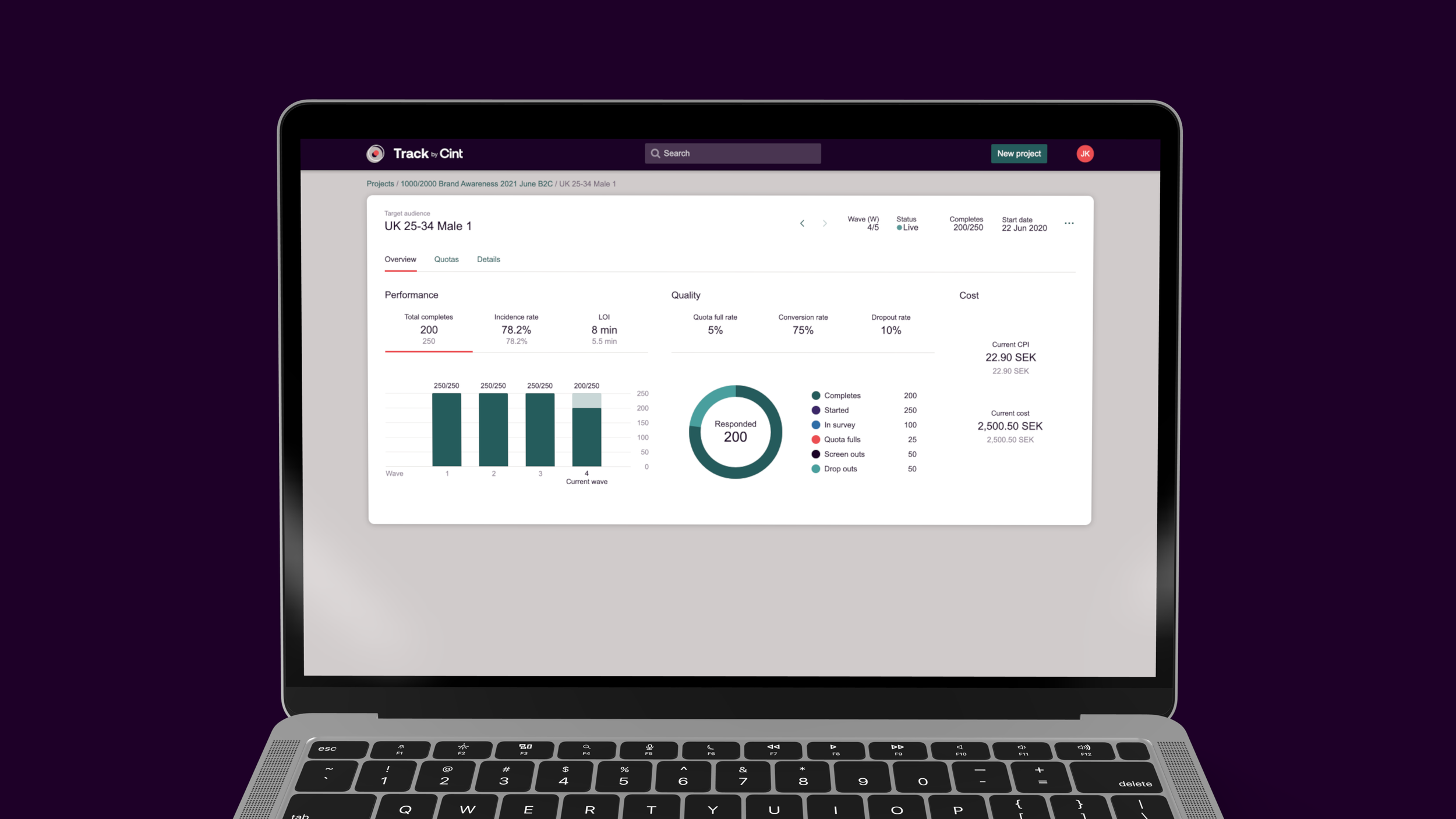
Track by Cint target audience dashboard